3D Printing in a Pottery Studio? It Makes Perfect Sense.

What will happen when a ceramic studio purchased a 3D printer
3D Printing in a Pottery Studio? It Makes Perfect Sense.
When people imagine a pottery studio, they usually picture clay, water, wooden tools, spinning wheels, and shelves filled with work waiting to be fired.
A computer and a 3D printer may seem like they belong somewhere else.
But honestly, 3D printing in a pottery studio makes perfect sense.
Clay has always developed alongside tools. Potters shape it with ribs, paddles, stamps, molds, templates, rollers, and whatever else they can find or invent. Every tool leaves behind a different pressure, texture, rhythm, or possibility.
At Dusty & Co, we are interested in what happens when some of those tools begin on a screen—and then return to the hand.
Where Digital Design Meets Clay
Our 3D printing and ceramics workshops are not about asking a machine to replace handmade pottery.
We are not trying to remove touch, irregularity, or intuition from the process. Those are the qualities that make clay worth working with in the first place.
Instead, we use digital design and 3D printing to create new tools for making by hand.
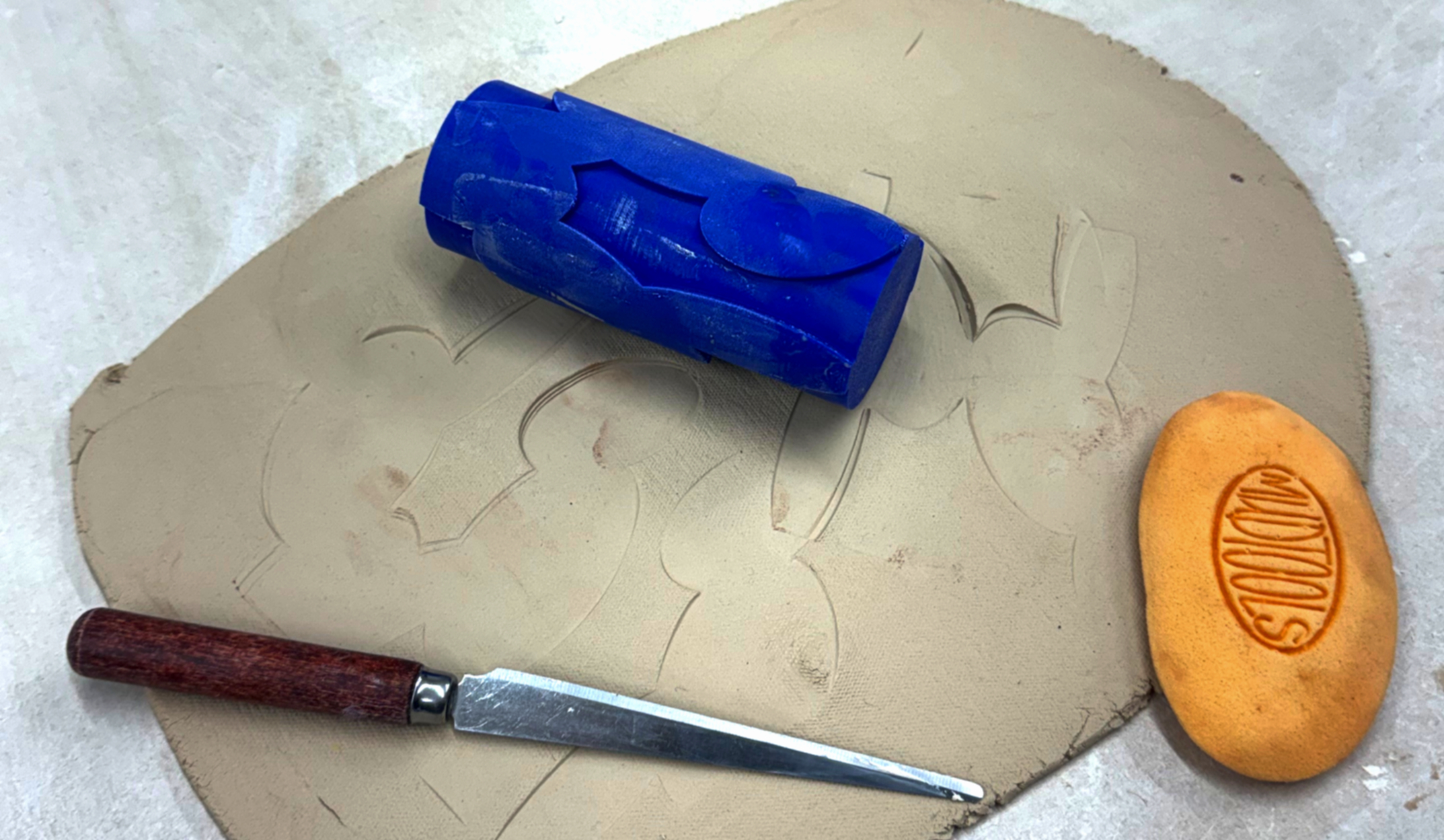
A curve designed on a computer can become a pottery rib. A digital drawing can become a clay stamp. A repeating pattern can be transformed into a texture tool. A modeled volume can become a mold for an entirely new ceramic form.
The process moves back and forth:
screen → printer → tool → hand → clay
The digital and physical stages do different things. Digital modeling gives us control over dimensions, repetition, geometry, and variation. Clay introduces gravity, pressure, moisture, movement, and the unexpected.
Neither process has to dominate the other. The interesting work happens where they meet.
What Can You Make With 3D Printing for Ceramics?
Dusty has developed a growing series of workshops exploring different applications of 3D printing in pottery and ceramic design.
Design and Print a Custom Pottery Rib
A pottery rib is a small shaping tool used to compress, smooth, and define clay. Its edge determines how it interacts with a vessel, so even a subtle change in curvature can produce a different profile.
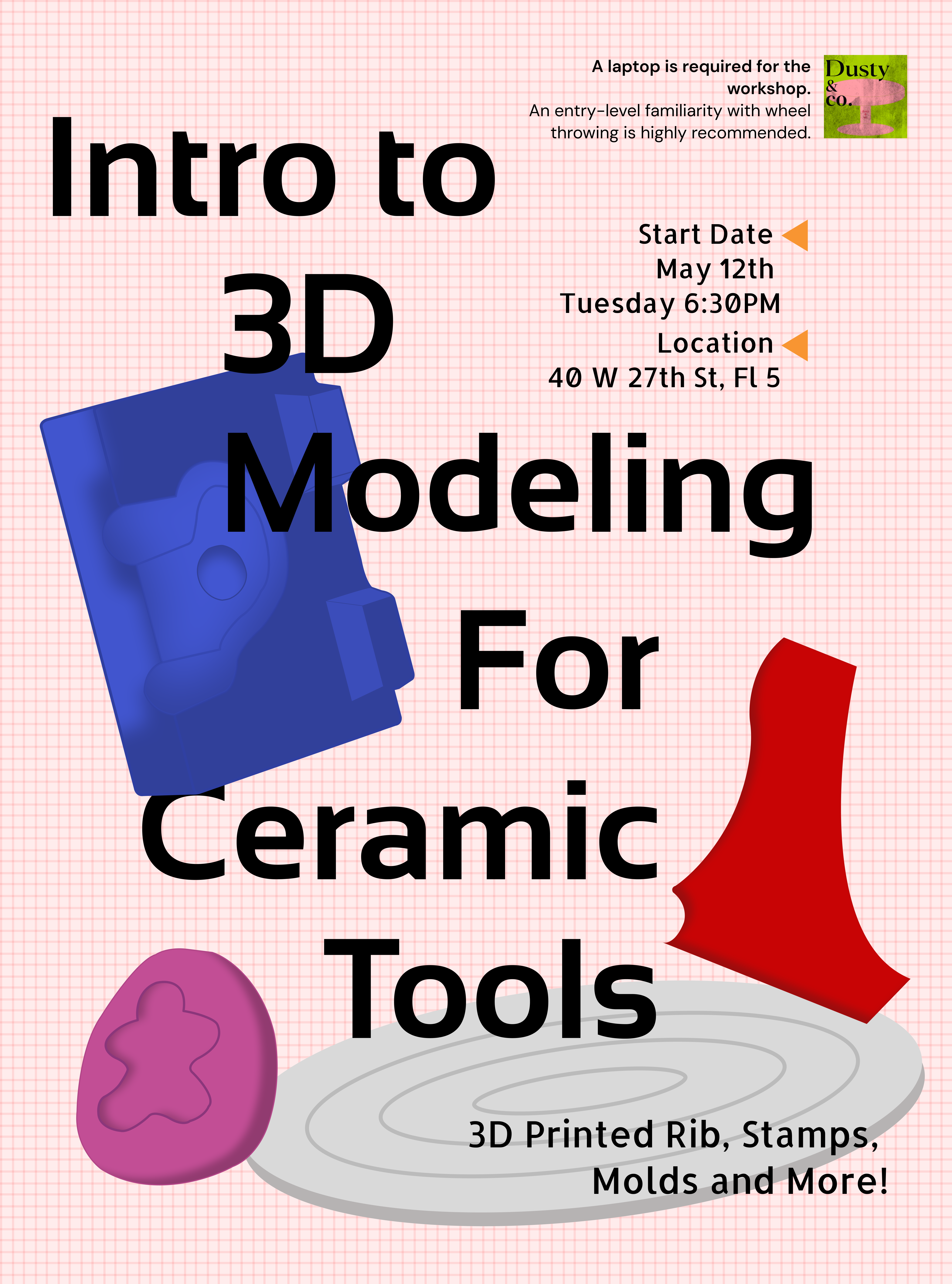
In our 3D Printing: Rib Making Workshop, participants design a custom rib based on the kinds of forms and gestures they want to create.
Your rib might have a long architectural curve, a sharp corner, an asymmetrical profile, or a completely unfamiliar edge. Once printed, it becomes a functional pottery tool that can be tested on slabs, coils, and wheel-thrown forms.
Instead of adapting your idea to a tool that already exists, you can design the tool around your idea.
Turn a Drawing Into a Ceramic Stamp
Stamps are one of the most direct ways to transfer an image, symbol, or mark into clay.
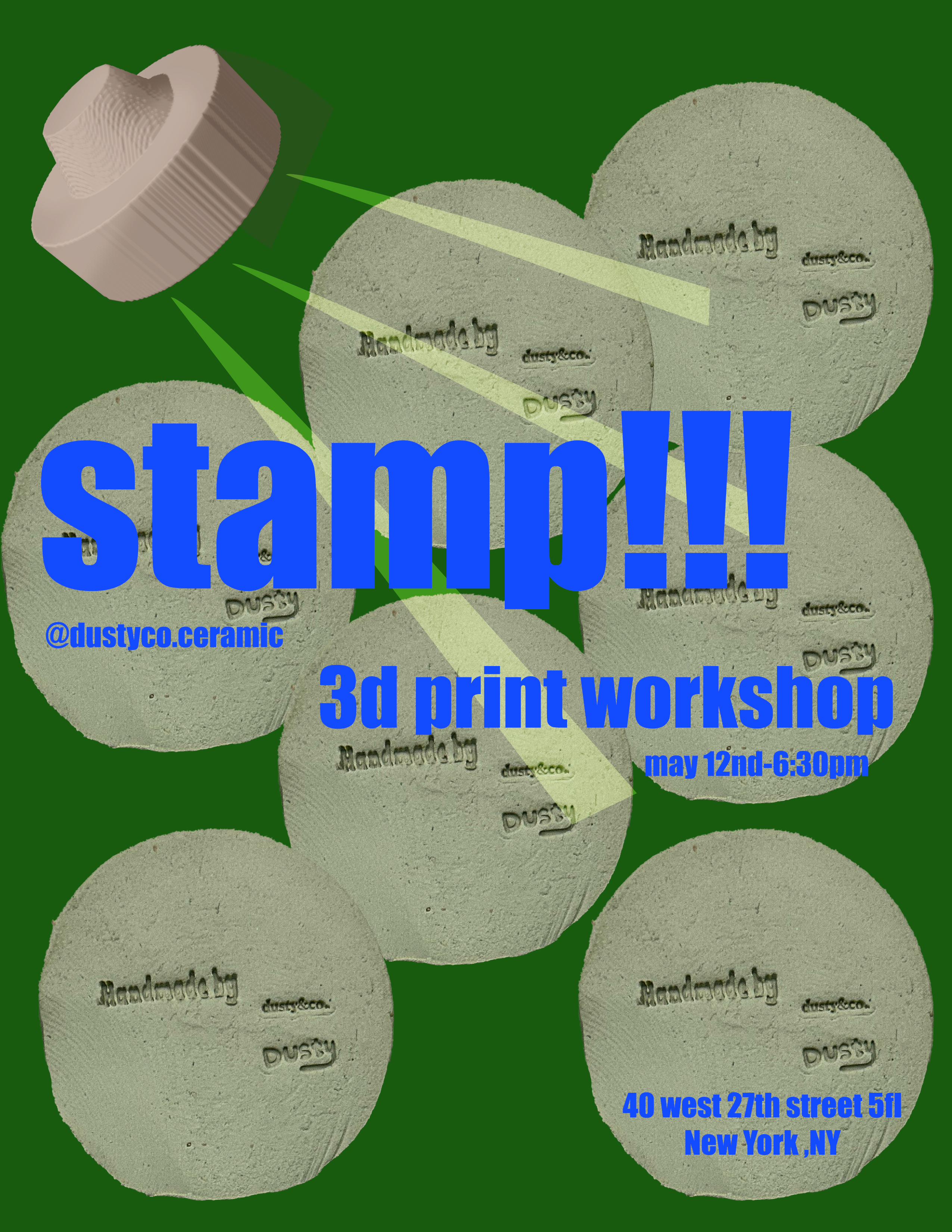
In our 3D Printing: Stamp Making Workshop, participants develop a design and translate it into a printable three-dimensional stamp. It might begin as a simple drawing, a monogram, a logo, a repeating motif, or a strange shape that does not have a name yet.
Once printed, the stamp can be pressed into soft clay again and again. A digital file becomes a physical tool; the tool creates an impression; the impression changes slightly each time it meets the clay.
It is repetition without perfect sameness.
Create Texture and Pattern Tools
Clay records touch exceptionally well. It can hold the trace of fabric, wood, stone, skin, found objects, and digitally generated surfaces.
Our texture and pattern workshops explore how digital design can produce rollers, stamps, paddles, and other tools for creating relief in clay.
Participants can work with geometric systems, organic textures, lettering, custom illustrations, or repeating patterns. The resulting tools can be used to create surface treatments for tiles, vessels, sculptural work, and handbuilt objects.
The goal is not simply to decorate the surface. Texture can influence how an object catches light, feels in the hand, and changes as glaze pools across it.
Experiment With 3D-Printed Molds and Forms
Molds allow ceramic artists to repeat, combine, distort, and build upon a form. With 3D modeling, the original form no longer needs to begin as a handmade physical object.
It can begin digitally.
In our 3D-Printed Molds and Form Experiments, we investigate how a digital model can support ceramic handbuilding, mold-making, slip casting, and sculptural construction.
A form can be stretched, mirrored, divided, scaled, or altered before it ever becomes physical. Once printed, it can be used as a mold, a template, an armature, or simply a starting point for further transformation by hand.
This opens up a space between craft, sculpture, product design, and digital fabrication.
Is This the Same as 3D Printing With Clay?
Not necessarily.
Ceramic 3D printing can refer to machines that extrude clay directly to produce a ceramic object. That is one fascinating area of experimentation, but it is not the only way 3D printing can enter a pottery studio.
At Dusty, many of our workshops focus on using 3D printers to create the tools, stamps, textures, molds, and systems that help shape clay by hand.
The final ceramic object is still touched, assembled, adjusted, glazed, and fired through a physical studio process.
The machine does not make the creative decisions for you. It gives you another way to materialize them.
An Interdisciplinary Approach to Ceramics
We think of ceramics as more than a single craft technique.
It can intersect with architecture, sculpture, graphic design, computation, industrial design, material research, and everyday problem-solving. Working across disciplines allows us to ask different questions:
What would a pottery tool look like if you designed it yourself?
Can a digital pattern become a tactile ceramic surface?
How does a perfectly repeated geometry change when it is pressed into soft clay?
Can a machine-made tool produce something that still feels unmistakably handmade?
Sometimes the outcome is practical. Sometimes it is beautiful. Sometimes it is simply a weird little tool that makes a mark we have never seen before.
All three are worthwhile.
Beginner-Friendly 3D Printing and Ceramics Workshops in NYC
You do not need previous experience in pottery, 3D modeling, or 3D printing to participate.
Our workshops are designed for curious beginners as well as ceramic artists, designers, architects, and makers who want to add digital fabrication to their creative process. We introduce the relevant tools and concepts, then help participants turn an idea into something physical and usable.
The point is not to become a software expert in one evening. It is to understand enough of the process to begin experimenting—and to leave with a tool or form that can continue producing ideas afterward.
Dusty’s 3D printing and ceramics workshop series includes:
Custom pottery rib design and printing
Custom ceramic stamp making
Texture and pattern tool development
3D-printed molds and form experiments
Private group workshops
Custom interdisciplinary workshop formats
No experience is required. Just curiosity.
Custom 3D Printing for Ceramic Artists and Designers
Dusty & Co also accepts select 3D printing commissions.
We can help ceramic artists, designers, studios, and brands develop custom ribs, clay stamps, texture tools, prototypes, molds, and other small-scale fabrication projects.
Depending on the project, we can work from an existing 3D file or help translate an early concept, drawing, pattern, or physical form into a printable design.
For workshop dates or custom 3D printing inquiries, contact Dusty & Co by email or send us a message on Instagram.
Come make weird little tools with us.
Frequently Asked Questions
Does Dusty offer 3D printing workshops in New York City?
Yes. Dusty & Co offers interdisciplinary 3D printing and ceramics workshops at its NoMad studio in Manhattan. Workshop subjects include pottery ribs, clay stamps, texture tools, molds, and experimental forms.
Do I need experience with 3D modeling?
No. Our beginner-friendly workshops introduce the digital and physical processes needed for each project.
Are we directly 3D printing ceramic clay?
Most workshops use 3D printing to create tools, stamps, textures, molds, or forms that are then used with clay. The specific process varies by workshop.
Can I design my own pottery tool?
Yes. Customization and experimentation are central to the workshops. Participants can explore original profiles, patterns, symbols, and forms.
Does Dusty accept custom 3D printing commissions?
Yes. We accept select commissions for custom pottery tools, stamps, molds, prototypes, and related ceramic applications. Contact Dusty & Co with your concept, reference images, dimensions, and desired use.


40 W 27th St
New York, New York 10001


Comments